
UK compliance
What UK regulations mean for your IT
Plain-English guides to the security and resilience rules UK businesses most often face, what each means for your systems, and how we help you meet and evidence them.
Download or read online
Choose a guide

Read this first
Compliance is yours; evidence is shared
Regulations apply to your business, and only you can sign the declarations. We provide the technical controls, the evidence and the advice. A certified or experienced supplier does not, on its own, make you compliant.
- Unfamiliar term? See the IT glossary
- Free to download and share: the full guide (PDF)
- Guides are summaries, not legal advice
- Regulations change: we review this page regularly
- Ask your legal or compliance adviser to confirm what applies to you
Regulation
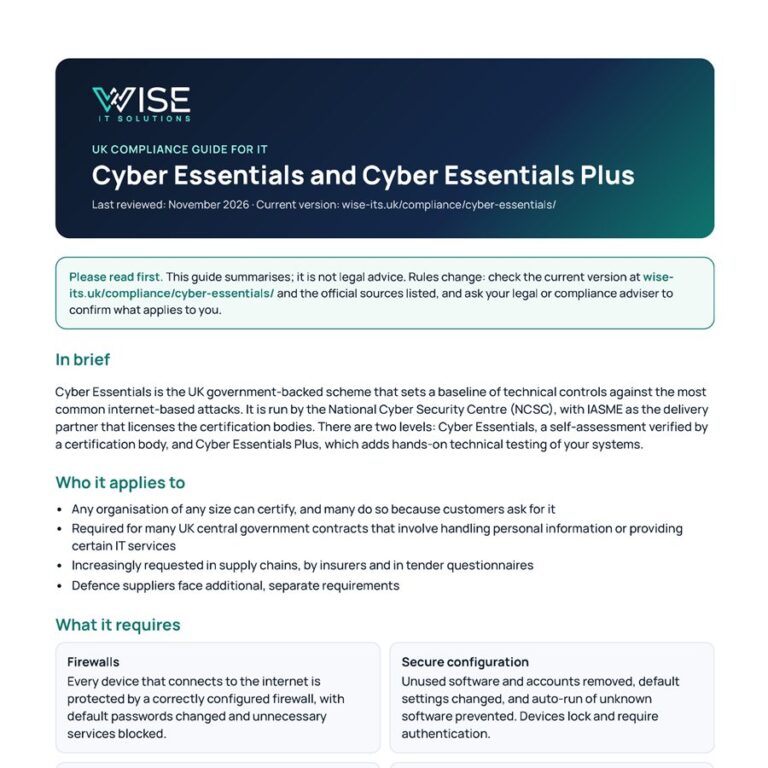
Cyber Essentials and Cyber Essentials Plus
Who it applies to
Any UK organisation. Required for some government contracts, and increasingly asked for by customers and insurers.
What it requires
A government-backed scheme covering five technical controls: firewalls, secure configuration, security update management, user access control and malware protection. Cyber Essentials is a verified self-assessment; Plus adds hands-on technical testing. Certification is renewed every year.
What it means for your IT
- Every in-scope device supported and updated within the scheme’s timescales
- Multi-factor authentication on cloud services
- Administrator rights kept to a minimum
- Evidence ready for the certification body
How we help: Cyber Essentials readiness · Cyber Essentials explained
Regulation
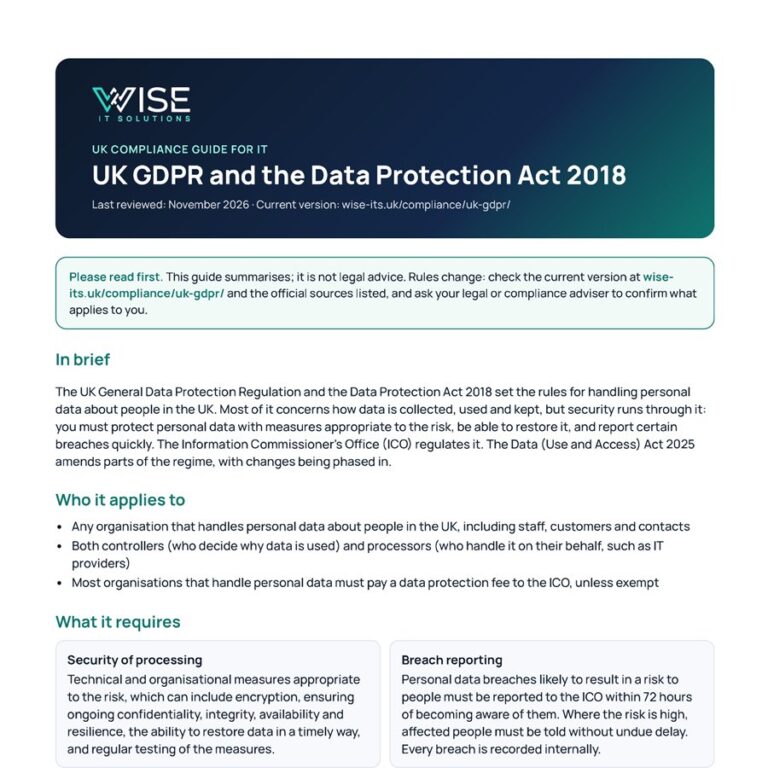
UK GDPR and the Data Protection Act 2018
Who it applies to
Any organisation handling personal data about people in the UK.
What it requires
Requires “appropriate technical and organisational measures” to keep personal data secure, and certain personal data breaches to be reported to the Information Commissioner’s Office within 72 hours of becoming aware of them.
What it means for your IT
- Access to personal data limited to people who need it
- Encryption on laptops and phones
- Backups that can be restored, and records of tests
- A way to detect, assess and record incidents quickly
How we help: Cyber security and incident response · Evidence register
Regulation
NIS Regulations and the CSR Bill
Who it applies to
Currently operators of essential services (such as energy, transport, water and health) and certain digital service providers.
What it requires
The NIS Regulations 2018 require in-scope organisations to manage cyber risk and report significant incidents. The Cyber Security and Resilience Bill, introduced to Parliament in November 2025, proposes extending this to managed service providers, data centres and critical suppliers. Check the current status, as the detail may change.
What it means for your IT
- Supplier security reviewed, including your IT provider
- Incident detection and reporting routes agreed in advance
- Risk management documented and reviewed
- Evidence that controls are working, not just written down
How we help: How we access your IT · Cyber maturity model
Regulation
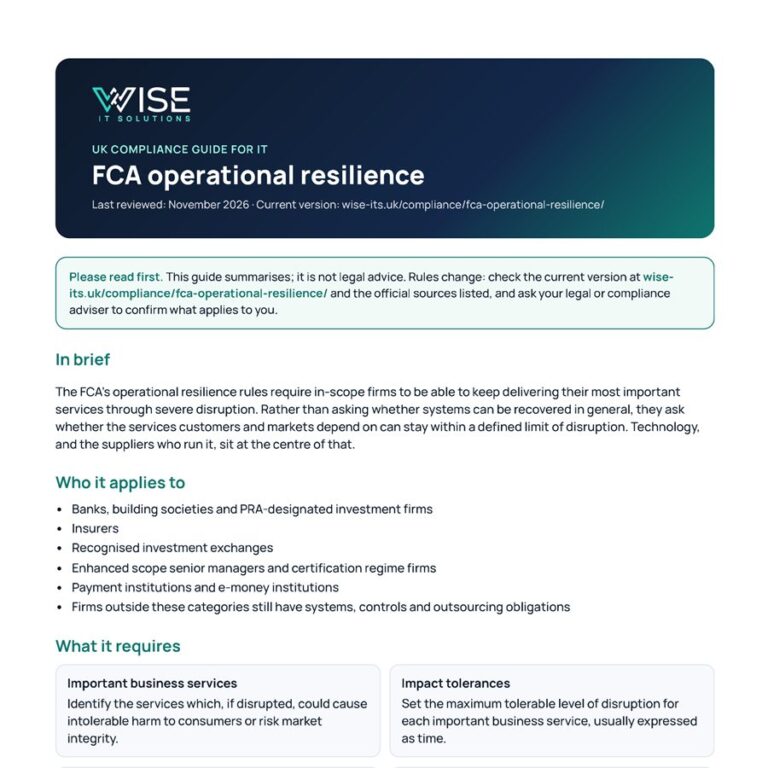
FCA operational resilience
Who it applies to
Many FCA-regulated firms, including banks, insurers and larger investment firms.
What it requires
In-scope firms must identify their important business services, set impact tolerances for how much disruption they can tolerate, and show they can stay within them, including through severe but plausible scenarios. The FCA’s deadline for firms to be able to remain within tolerance was 31 March 2025.
What it means for your IT
- Systems mapped to the business services they support
- Recovery tested against impact tolerances
- Third-party and outsourcing risk managed
- Scenario testing recorded, with lessons acted on
How we help: Backup and disaster recovery · Tabletop exercise
Regulation
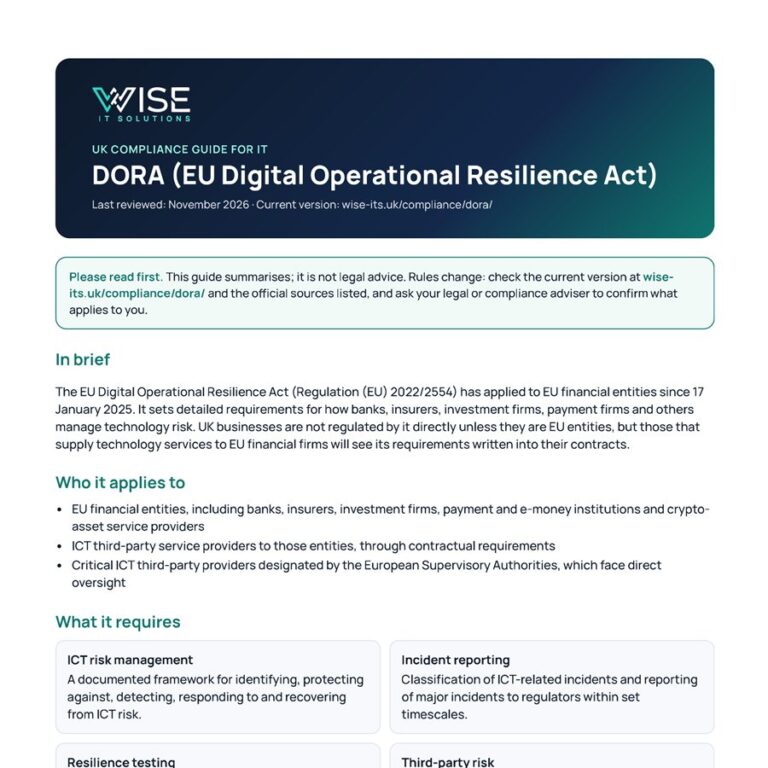
DORA (EU Digital Operational Resilience Act)
Who it applies to
EU financial entities since 17 January 2025, and in practice UK businesses that supply them with technology services.
What it requires
DORA sets requirements for ICT risk management, incident reporting, resilience testing and the management of ICT third parties. UK suppliers to EU financial firms may be asked for contractual commitments on security, incident notification, audit access and exit plans.
What it means for your IT
- Clear contractual terms on incident notification and exit
- Evidence of security controls and testing
- Documented subcontractors and delivery partners
- A tested exit plan for the service
How we help: Trust centre · Contracts and switching
Regulation
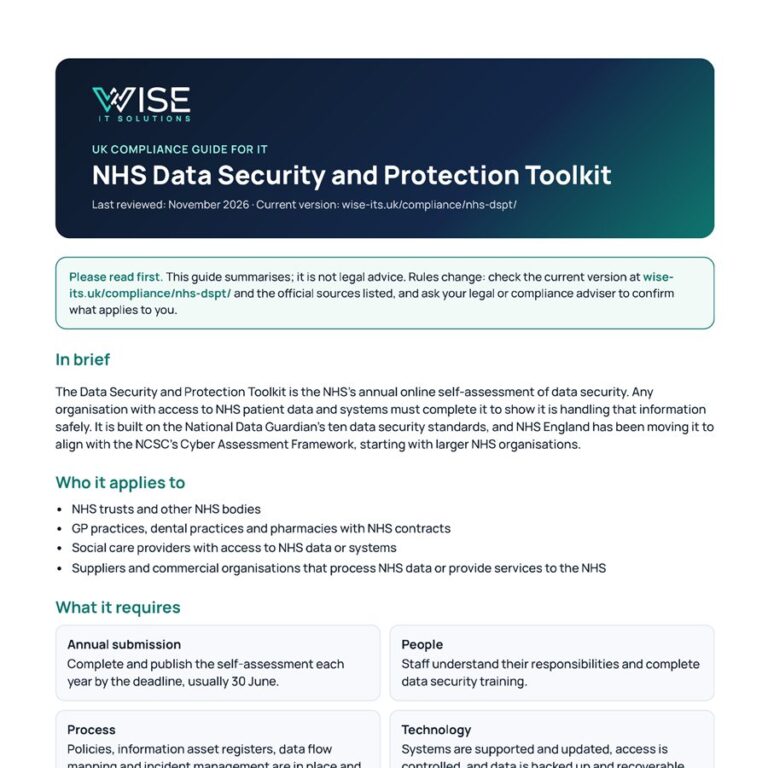
NHS Data Security and Protection Toolkit
Who it applies to
Organisations with access to NHS patient data and systems, including many suppliers and care providers.
What it requires
An annual online self-assessment of data security and protection. NHS England has been moving the toolkit to align with the National Cyber Security Centre’s Cyber Assessment Framework, so requirements for some organisations are changing.
What it means for your IT
- Staff training and access controls evidenced
- Devices and systems supported and updated
- Backups and business continuity tested
- Incidents reported through the right routes
How we help: Cyber security · IT manager cover checklist
Regulation
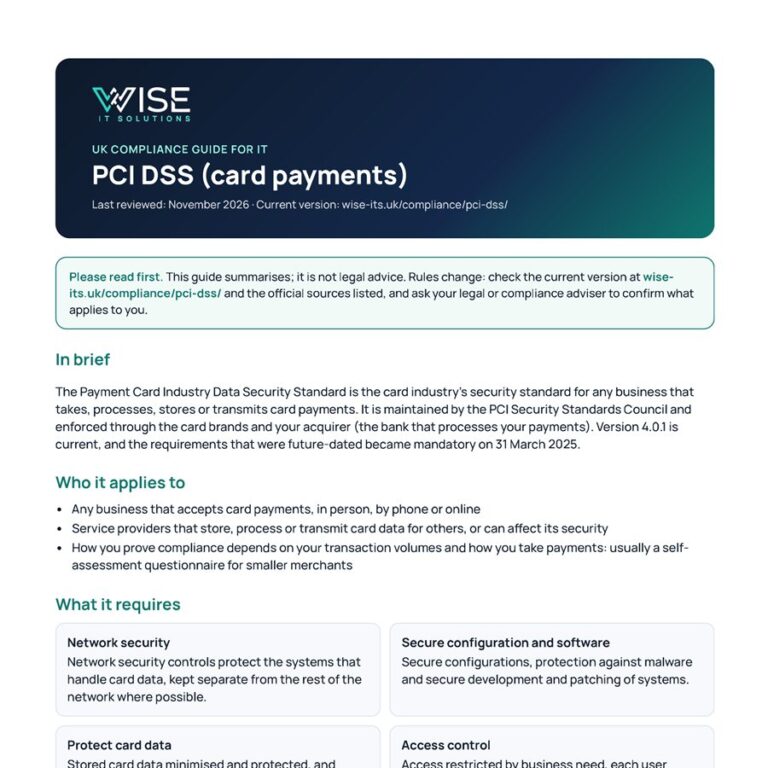
PCI DSS (card payments)
Who it applies to
Any business that takes, processes or stores card payments.
What it requires
The card industry’s security standard. Version 4.0.1 is current, and its future-dated requirements became mandatory on 31 March 2025. Your payment provider tells you which self-assessment applies.
What it means for your IT
- Card systems kept separate from the rest of the network
- Multi-factor authentication for access to card data environments
- Updates and malware protection on payment devices and systems
- Logs kept and reviewed
How we help: Networks and communications · Cyber security
Facing a questionnaire, audit or renewal?
Tell us which regulation or customer requirement you are working towards. We will show you where you stand and what evidence you need.
Talk to us about your IT.
A free, no-obligation conversation about what is slowing your team down or what you are planning next. We will arrange a time that suits you.